
Long AI Short AGI
We are not short on ambition, just short on hype

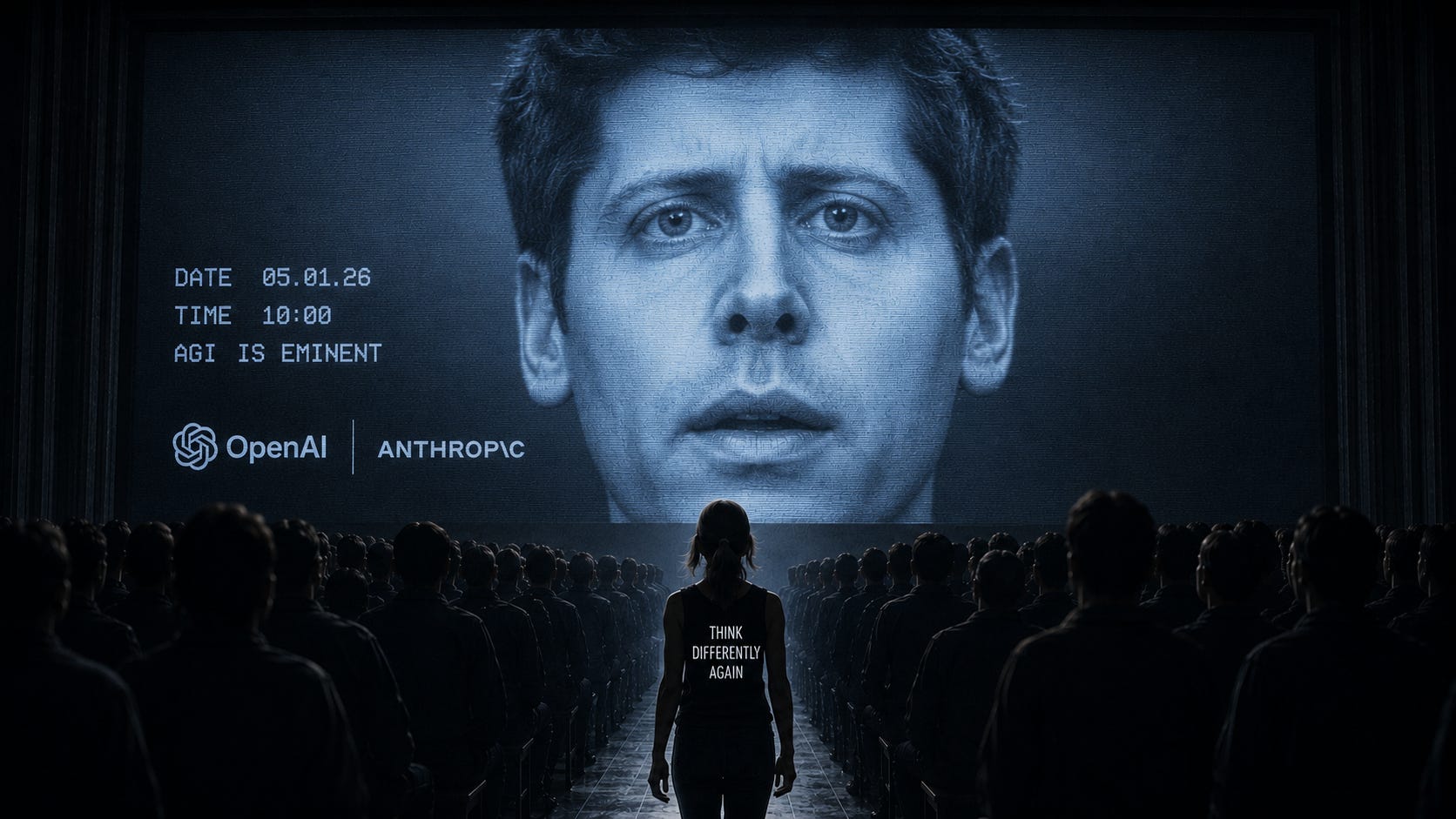
There’s a story Silicon Valley really wants you to believe right now.
It goes like this: intelligence itself is the scarce resource. Whoever builds the most powerful model will, in Sam Altman’s words, “capture the light cone of all future value in the universe.” The argument goes even further: that the first company to reach AGI will permanently leapfrog everyone else. Everything else — the apps, the workflows, the industries — becomes downstream. Just features waiting to be absorbed.
It’s an elegant story that’s supported by the shortage in inference capacity. It is also a very convenient one for the hundreds of billions of dollars now concentrated around a handful of companies.
But it’s mostly hubris. And we’re betting against it.
Models are commoditizing fast
Two years ago, GPT-4 class intelligence cost roughly $30 per million tokens. Today, similar performance is available for under a dollar. Meanwhile DeepSeek, Kimi, and Qwen keep closing the gap at an even smaller fraction of the cost.
None of this should be surprising.
Compute commoditized. Bandwidth commoditized. Storage commoditized. None of those looked like commodities when they first appeared either. They looked magical, scarce, and impossible to catch. Then markets did what markets always do: competition increased, supply expanded, and differentiation collapsed. Intelligence is heading down the same path.
Infrastructure captures pennies on the dollar
The historical parallels are everywhere. The railroads didn’t dominate the industrial economy. Standard Oil did. AWS created enormous value, but the defining companies of the cloud era became Stripe, Shopify, and Snowflake.
The AI-native companies that define the next decade probably won’t win because they have a marginally better model. In fact the models are already good enough to transform most industries. They’ll win because they own the customer relationship, the proprietary data, and the workflow that’s too painful to replace.
At Tellme Networks, one of the first voice enterprise AI companies, we were making over $120M in revenue automating call center for enterprises. We didn’t have our own voice recognition engine. Instead we used Nuance, the most advanced provider at the time, and paid them pennies on the dollar. They were competing with us on every contract—and losing. Because we had the best applications targeted for each vertical.
Short on hype, not ambition
More importantly, the most important AI companies probably haven’t been founded yet.
Google wasn’t obvious in 1993. Amazon wasn’t obvious in 1996. The founders building the defining companies of the AI era are likely out there right now, working on problems that still sound too niche, too messy, or too early. We don’t know who they are yet — and neither does anyone else
But we’ve also seen enough cycles to know that the most important companies are never built by the people who own the infrastructure. They’re built by the people who can’t stop thinking about a specific problem nobody else thinks is worth solving yet.
That’s the long AI bet.